Showing posts with label solar car. Show all posts

Thursday, January 12, 2012

Geely IG Solar Hybrid Car Revealed in Beijing Read: Geely IG Solar Hybrid Car Revealed in Beijing | TFTS

This week at the Beijing Motor Show 2010, Geely Motors revealed a new fleet of hybrid and electric vehicles including this bug-inspired solar hybrid.  The Geely IG Solar Hybrid Car is powered by a hybrid powertrain and features a solar panel skin to help run its components and power system.


After its first tease as a concept vehicle at the Shanghai Motor Show 2009, the Geely IG (Geely Intelligence) has been re-tooled to showcase new hybrid technologies the marque has been developing.  The new Geely IG features solar panels on its hood and roof, a new 2 by 2 seating orientation and playful seagull doors.  What’s not clear is exactly how the solar panels interact with the electric half of this vehicle’s hybrid drivetrain.  Other cars, like the Aptera Typ-1, plan to use solar panels to power heating/cooling and other electrical needs independent of the hybrid engine’s power.  Geely’s short press release did not discuss how these solar panels will integrate with the Geely IG.
The Geely IG solar hybrid car was revealed to the public along with other green-minded autos in Geely’s fleet.  Along with the IG, Geely announced the EK1 and EK2 light electric vehicles and the Geely GPEC, a plug-in electric hybrid vehicle with a 60-km electric-only driving range

Green Cars: Hyundai 2020 Family Car Runs On Water And Sunlight


Hyundai 2020, Solar cars, Water cars, eco cars, green cars, futuristic cars, Concept cars, Future Car, Future Auto, Future Vehicle
Eco Factor: Zero-emission concept car powered by electricity.
MIT recently developed technology that could soon end up in cars that could recharge in seconds. But for some designers quick recharging isn’t the only way electric cars could be promoted. Designers like Nicolas Stone believe solar energy is the future and cars manufacturers should sooner or later venture into designs that generate their own fuelwith on-board systems.
Hyundai 2020, Solar cars, Water cars, eco cars, green cars, futuristic cars, Concept cars
The designer has come up with a new family car designed for Hyundai dubbed the Hyundai 2020. The small car is aimed toward a family of four people.
Hyundai 2020, Solar cars, Water cars, eco cars, green cars, futuristic cars, Concept cars
Inspired by plants, the car generates fuel for itself using nothing more than sunlight and water, the two fuels for plants to carry out their natural processes.
Hyundai 2020, Solar cars, Water cars, eco cars, green cars, Future Car, Future Auto, Future Vehicle, futuristic cars, Concept cars
The transparent solar cells that the car is equipped with generates electricity from ambient light and uses it to carry out electrolysis of water, finally generating hydrogen, which fuels the car.
Hyundai 2020, Solar cars, Water cars, eco cars, green cars, futuristic cars, Concept cars
The only by-product of the car engine will be clean potable water and breathable oxygen.
Hyundai 2020, Solar cars, Water cars, eco cars, green cars, Future Car, Future Auto, Future Vehicle, futuristic cars, Concept cars
The Dark Side:
The overall design of the car looks pleasing and the technology used by Nicholas ensures a pleasant ride. However, splitting water into hydrogen and oxygen and then storinghydrogen in an on-board tank seems a complicated and a risky mechanism, not to mention the cost of incorporating this technology in a small car.

Solar vehicles


Development of a practical solar powered car has been an engineering goal since the 1980s. The center of this development is the World Solar Challenge, a biannual solar-powered car race in which teams from universities and enterprises compete over 3,021 km (1,877 mi) across central Australia from Darwin to Adelaide. In 1987, when it was founded, the winner's average speed was 67 km/h (42 mph)[76] The 2007 race included a new challenge class using cars with an upright seating position and which, with little modification, could be a practical proposition for sustainable transport. The winning car averaged 90.87 km/h (56.46 mph).

Helios UAV in flight


Helios, named for the Greek sun god, was a prototype solar-powered unmanned aircraft. AeroVironment, Inc. developed the vehicle under NASA's Environmental Research Aircraft and Sensor Technology (ERAST) program. On 13 August, 2001, it set an unofficial world record for sustained altitude by a winged aircraft. It sustained flight above 29,250 m (95,965 ft) for 40 minutes and reached 29,524 m (96,864 ft) altitude in the process.

A solar balloon is a black balloon that is filled with ordinary air. As sunlight shines on the balloon, the air inside is heated and expands, causing an upward buoyancy force, much like an artificially-heated hot air balloon. Some solar balloons are large enough for human flight, but usage is limited to the toy market as the surface-area to payload-weight ratio is rather high.

The first practical solar boat was constructed in 1975 in England.[78] By 1995, solar passenger boats began appearing and are now used extensively.[79] The first crossing of the Atlantic Ocean by a solar-powered boat was in the winter of 2006/2007 by the catamaran sun21.

Solar sails are a proposed form of spacecraft propulsion using large membrane mirrors. Radiation pressure is small and decreases by the square of the distance from the sun, but unlike rockets, solar sails require no fuel. Although the thrust is small compared to rockets, it continues as long as the sun shines and the sail is deployed and in the frictionless vacuum of space significant speeds can eventually be achieved.

Midier Solar Concept Car


Futuristic Vehicle, Siyang Liu, Midier

Designed by Siyang Liu, the Midier is a car that seems more like what Apple and Steve jobs would roll out on for a big iPhone unveiling, rather than another concept design. That is what separates it from the mob when it comes to the design aspect of things. But the real distinguishing factor is the solar panel on top of the car that juices up all its needs. The Midier is a car that sports a sexy design and has the “cool factor.”

How fast can solar cars go?


The Honda Dream solar car races through Australia as part of the World Solar Challenge.
AP Photo/Steve Holland
While solar-powered cars remain the stuff of science fiction tales for most of us, some forward-thinking engineers have been building -- and racing -- them for years. But designing a car to run on solar power is a tall order.
Solar panels aren't incredibly efficient -- most commercial panels can only boast an efficiency rating of around 15 percent. That means the panel is only able to convert 15 percent of the sunlight it receives into electricity. Some manufacturers have managed to get up to 42 percent efficiency in lab tests.
Solar-powered cars use electric motors instead of internal combustion engines. And most solar-powered cars are light, one-person vehicles. The lighter the vehicle, the less work the motor has to do to move the car. Vehicles tend to be flat and wide to maximize surface area while still being aerodynamic. Many solar-powered cars have a maximum speed between 40 and 60 miles per hour (64.4 and 96.6 kilometers per hour). That's not enough to make your average highway patrol officer bat an eye.
But the University of Michigan Solar Car Team raced a car in 2010 that could earn a heavy-footed driver more than a few speeding tickets. The team's car, called the Infinium, reportedly reached the record-breaking speed of 105 miles per hour (169 kilometers per hour) during a qualifying race for the American Solar Challenge, an annual solar-powered car race.
The University of Michigan team went on to win the 2010 American Solar Challenge. The six-day race was a tough 1,100-mile (1,770-kilometer) course and the car averaged 40 miles per hour (64.4 kilometers per hour) on a route that included intersections with stop lights.
As solar panel technology improves, we may see engineers incorporate it into other electric vehicle designs. While the cars in the solar races aren't meant for the average driver, other electric vehicles may use solar power to extend the distance they can travel before requiring a recharging station. Such vehicles won't be strictly solar-powered. But it may help bridge the gap between prototype race cars and practical vehicles. It may also give green drivers even more speed -- the Tesla Roadster, an electric sports car, has a top speed of 125 miles per hour (201.2 kilometers per hour)!

The Volkswagen Solar Supercar


In the new millennium, there has been a concentrated effort by automotive engineers and global automotive manufacturers to design cars that could run on an alternate source of fuel other than fossil fuels. Electric and battery-powered vehicles are the most visible alternative to fuel-powered vehicles.
The Toyota Prius, which is a hybrid between an electric and fuel-powered engine, represents the first step taken by a major auto manufacturer to mass-produce an environmental-friendly vehicle that runs on a combination of fuel and electricity-powered engine.
There has also been a lot of research and development done to harness the limitless energy of the sun and power our vehicles with it.
Volks wagen supercar 1 The Volkswagen Solar Supercar
Solar-powered vehicles have long been a fancy of design engineers. Solar cars, however, have been usually relegated to niche competitions. Unlike electric and battery-powered vehicles, there has been no concrete effort to produce asolar powered car for the public.
Volks wagen supercar 2 The Volkswagen Solar Supercar
Another obstacle that the solar cars need to overcome is their hideous design sense. The obtuse body frame of solar-powered vehicles makes one wonder why would anyone ride them in the first place. No matter how beneficial they are to the environment.
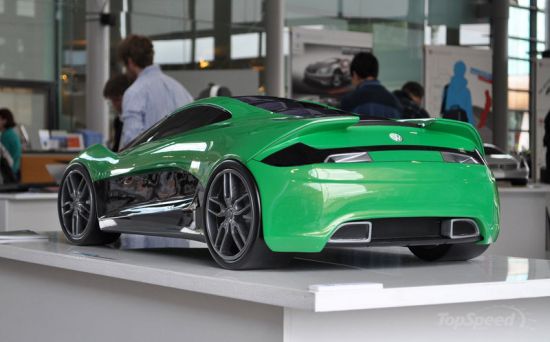
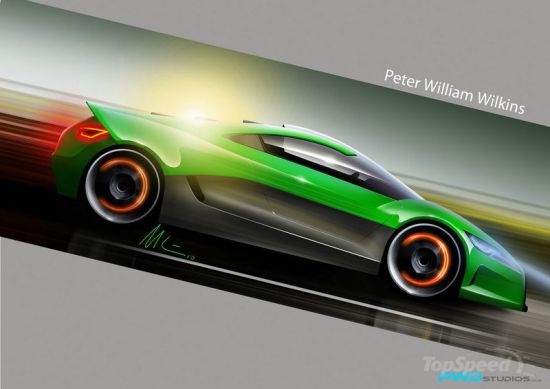
Designer Paul Wilkins has overcome the design conundrum of sun-powered vehicles by designing a solar car concept that has an exquisite design aesthetic. Paul Wilkins has collaborated with German auto manufacturers, Volkswagen (pronounced Folkswagen), and conceptualized a solar-powered supercar that walks the tightrope between sophisticated beauty and potent functionality. The intelligent design of the car includes integrated photovoltaic cells that line the external body of the vehicle which absorbs the sun’s abundant energy and powers the hydrogen fuel cell stack.
If the Volkswagen solar-powered supercar’s eco-friendly engine will impress you, its breathtaking body design will simply blow your mind.
The exoskeleton of the solar supercar is a sleek, smooth, aerodynamic design. Green and black color tones paint the car in a racing-stripe inspired design. The car borrows its external design elements from the Volkswagen Scirocco with a dominant front grill, forward-pitching nose, and curved side-features. There are slit panels, which aid down force, located at the rear, behind the cockpit.
The Volkswagen solar supercar is currently on display at the 2010 Swansea Metropolitan University Degree Show as a concept design. This concept design will be manufactured as a luxury car and will be assembled in a limited number. It is slated to hit the roads in 2020.

Advance Solar Car Splits Into Two Smaller Cars Details: http://thetechjournal.com/green-tech/advance-solar-car-splits-into-two-smaller-cars.xhtml#ixzz1jEtBfFit


Central and Eastern Europe might not be the first places you think of when it comes to electric cars. In fact, you’re probably more likely to think of bad cars, such as the infamous Yugo, dubbed the worst car in history.
Although it’s not particularly known for its autos, Hungary is taking a stab at the electric vehicle market with a futuristic new solar-electric car. Founded by auto enthusiasts and backed by local investors, the Hungarian company Antro, is working on a prototype for a modular car that is capable of splitting into two separate vehicles. With solar panels on the roof, the three passenger Antro Solo can run up to 20 km per day on solar energy alone.
Hungarian electric car splits into two smaller cars
The environmentally-conscious company started research back in 2002 and, with backing from various local sponsors, has invested 1.5 million euros in market research and development of a working prototype.
The Antro Solo concept is a three-passenger car, with a hybrid drive and solar cells on its roof that the company says could generate enough electricity for up to 20km a day at city speeds.
Futuristic looking in itself, the grander plan for the car is much more audacious: Antro intends to allow users to be able to connect two Antro Solos to form a six-passenger Antro Duo. Or perhaps more interesting still, owners of a Duo could split the car into two smaller Solos should Mum have different weekend plans to Dad. Or if they divorce.
The current prototype looks interesting, but I can’t believe its chances of ever making it to past the prototype stage are much above slim.
antro, antro solar, solar electric vehicle, solar panels, solar  cells, solar vehicle, hungary
Also worth a mention, just across the border to the south of Hungary, is a Croatian company called Dok-ing. It specialises in making landmine clearance machines, and sports the company motto: “Don’t send a man to do a machine’s job.” But it, too, has launched its own project for a small electric city car called Dok-ing XD — a fully electric three-seater that promises to travel 155 miles on a single two-hour charge.
The project was disclosed in 2009 after four years of development. But like Antro, Dok-ing XD sounds and looks good, but the likelihood of it hitting mass production are low. Local media hype followed announcement of the project last summer, but there has been no news since. The working prototype was expected to be on roads by the end of last year, which led to mass production being optimistically scheduled for middle of 2010.


Details: http://thetechjournal.com/green-tech/advance-solar-car-splits-into-two-smaller-cars.xhtml#ixzz1jEsz5QmQ
 

Fiat Phylla Solar Car Uses Hydrogen Fuel Cell


Fiat Phylla
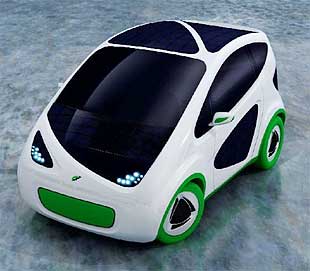
The Fiat Phylla is a solar and hydrogen fuel cell powered city car made in Italy with unique design and styling. Presented at the Uniamo le energie in Turin, the Fiat Phylla (meaning “leaf”) was de-shrouded before an excited crowd.
The Fiat Phylla prototype is so new and raw that the carmaker does not yet have a vehicle that can run under normal conditions. Designed to use its photovoltaic panels to absorb the sun, the Fiat Phylla is also a plug-in hybrid as a well, which is usually for night time or when the solar rays aren’t shining.The Fiat Phylla was also built from the ground up using recyclable cellular materials giving it a near zero carbon footprint. With a top speed of around 48 mph, this urban vehicle uses its fuel cell to deliver power directly to each of its four wheels.
Mark up another success for Italian design. The Fiat Phylla feels like fun and frolic the way a zero emissions vehicle should feel free to feel. 


10 amazing solar-powered cars developed by students


The ever-spiraling cost of fuel and its equally harmful effects on the environment has forced many to think of newer and greener sources of energy for their cars. The breakthrough came when Ed Passerini (in 1977) constructed his own completely solar-powered car called the "Bluebird" and Larry Perkins drove his "Quiet Achiever" in 1982. Since then the automotive industry has been looking toward the innovative applications of solar power. Solar cars use photovoltaic cells to convert the sun’s rays into usable energy.
solar car 1
solar car 1
Since most solar cars are designed as race cars, this trend has contributed in a big way for the initiation of the global solar car races namely the World Solar Challenge, Australia (started in 1983, this 3,012-kilometer race goes across Australia and happens every three years.) and the Toyota American Solar Challenge (a 3,862-kilometer ace from Dallas, Texas, to Alberta, Calgary). These global races have also inspired many entrants include school, corporate and hobbyist teams in this field. Invigorated by this spate of attention, several consulting companies, such as Phoenix Snider Power, have started offering them technical and financial services for developing solar cars worldwide. Some of the most creative solar cars invented by the students are listed below:
• Sunswift Ivy
sunswift ivy
sunswift ivy
This state-of-the-art solar-powered car has been designed by students and faculty at the University of New South Wales (UNSW). Their claim to fame came when they set a new record for the Guinness World Land-Speed record for a solar-powered vehicle in January 2011. Sunswift Ivy drove at 88 km/hr on roughly 1500 Watts.
The vehicle built on “open-sourced” experience of engineers, hackers, and tinkerers around the world comprises of a full scale multi-disciplinary, student-led solar racing team. Their dream was made possible by $280,000 AUD funding made by liberal donors and corporate sponsors and of course by the UNSW.

The car weighs about 1/10th of a conventional car and equipped with a 98% efficient Brushless CSIRO 3 phase DC motor needs just 1300 watts of solar generated power to achieve its estimated average speed of 85 km/h.
• SC4 Solar Car
sc4 solar car 1
sc4 solar car 1
This car has been designed by three engineering students from the Department of Traffic Engineering of Vietnam’s Da Nang University of Technology. Ta Ngoc Thien Binh, Huynh Kim Trang and Pham Nguyen Son under the careful and supportive guidance of Duong Viet Dung, a teacher from their faculty, has come up with a solar car which can hit a maximum speed of 30kph and weighs around 350 Kg. The SC4, which costs about US$4,200, can run for 30km on single charge and can also run on liquefied natural gas(LPG). Based on the technology invented by Professor Dr Bui Van Ga, the car runs by a heat engine using LPG (which is built along the electricity engine) when the supply of electricity runs out or there is no sunlight.
• Advay II
advay ii 1 7v7cz 11446
The 10th Auto Expo January 2011 New Delhi witnessed a unique futuristic yellow solar car calledAdvay II, which was designed by a group of 16 resourceful students from the Netaji Subhash Institute of Technology, Delhi University.
The non-polluting, zero-emission vehicle, is only 5 meters in length with aluminum interiors. The carbon fiber-reinforced sheets and polyurethane foam mixture used to make the exterior body of the car has helped in reducing the weight of the car to 380 kg. Furthermore, the aerofoil design of the car offers minimum resistance to air making the car fast and aerodynamic.
• SolarWorld No.1
solar car 1
solar car 1
This car is as close as possible to our dream of having a cleaner greener primary mode of transport. The car being the fruit of hard labor of over two years by a team of 50 students and professors from the University of Applied Sciences Bochum in North America performs at an average speed of 73km/h with a top speed of 120 km/h over 3000 km in the race. SolarWorldNo.1 is powered by an electric motor which is built into the front wheel rim and can deliver 94% degree of efficiency drawing energy from 6m2 solar cells, which are embedded in the body. Owing to its efficient design it came in at 4th place at the World Solar Challenge held in Australia while also winning the Best Challenge Class Design Award.
• TMT Palestine’s first solar electric car
tmt solar car
tmt solar car
Palestine is finally seeing a greener horizon, and has rolled out its first solar powered set of four wheels. A group of engineering students from the Palestine Polytechnic University in Hebron have turned to harness its warm sunny weather with about 300 sunny days per year to design a solar car which closely resembles a golf cart and is called as the TMT. Using 24 volts that is drawn from its 12 batteries the car can power up for 3 to 5 hours.
• Bethany
bethany
bethany
A team of students at the Cambridge University have developed a new solar car, entitled the “Bethany”, which can cruise at 60 mph, using the same amount of energy as a conventional hairdryer. Weighing just 170kg, the car generates energy using an array of high-efficiency silicon cells which together creates the car’s solar skin. Apart from generating energy from the sun, the car has been incorporated with regenerative braking systems, which recharge the car’s batteries when brakes are applied. “Bethany” has been designed using the latest computer simulation software, which gives it the ability to run at 50 times less power than a normal petrol-fueled vehicle. In June, the car will be competing in the World Solar Challenge race from Darwin to Adelaide, a distance of over 3,000km. The technology used in the car does give it the edge. However, costing £200,000, the technology cannot be used in commercial cars.
• Siemens Sunchaser
sunchaser
sunchaser
Working along with Siemens LLC, students at the American University of Sharjah (AUS) have developed a solar-powered car they call the Sunchaser. Designed as a regional prototype for vehicles, the Siemens Sunchaser is powered by 740 Sanyo HIT 220 watts and BP 35U 50W solar panels that are divided into four sub-arrays. Together the solar panels charge 30 Kokam 40Ah lithium-ion batteries. The power from the lithium-ion battery pack is transmitted to two brushless DC motors which deliver a total torque at the rated speed of 20.8Nm, allowing the car to run at a speed of around 90km/h while operating at 115 volts. The car will remain on the AUS campus, where its features will be optimized for greater performance.
• Ford Model-T replica
solar truck
solar truck
A student team at the Waterloo Collegiate Institute has designed a solar-powered truck modeled on the famous Ford Model-T design and hence named as the Ford Model-T replica. Built on a sponsorship of just $4300, won from the Reduce the Juice Foundation that promotes projects that reduce emissions, the vehicle has a golf cart gearbox, a computer joystick and a “suicide switch” that automatically stops the truck if the driver falls off. The team states that the solar truck can top out at 50kph, which is decent considering that it’s their first attempt.
• Infinium solar car
infinium
infinium
Students of the University of Michigan have developed a solar car called Infinium, powered entirely by the solar panels which cover the entire body of the sleek and lightweight car. The 600-pound car is made from a lightweight composite material that allows the car to reach a top speed of 80-100mph. After winning the 2010 American Solar Challenge (a 1,200 mile race from Tulsa, Okla. to Naperville) for the sixth time at a row, the group is now raising money by seeking donations for the equipment and the cost to race in Australia, which will add up to $2.4 million.
• Apollo’s Chariot
apollos chariot 1
apollos chariot 1
A team of students of the American University of Beirut has come up with a steel and fiberglass one-seater solar car called Apollo’s Chariot after nine months of hard-working tutelage under their professor Daniel Asmar. The car weighing about 1,500 pounds is about 18 feet in length and 6 feet of width. Three dozen photovoltaic cells on the car’s body produce about 1,000 watts of electricity, stored in batteries built into the car. Built with about of $25,000 the car as promised by one of their designers, Amin Kanafani, can go as fast as 40mph. The designers hope to represent Lebanon in next year’s World Solar Challenge, a 2,000-mile Australian car rally for sun-powered vehicles.
Related Posts Plugin for WordPress, Blogger...